RDLLM Live Use Cases
These use cases are copyable from a source checkout. They show the user-facing answer surface and the backend attribution fields together, so builders can see where each claim, source, support score, and candidate allocation appears.
Synthetic fixtures: these examples use fictional creators, works, URLs, revenue, and allocation values. They do not prove model training influence or payment execution.
Live Screenshot Gallery
These screenshots are captured from local RDLLM runtime commands. They are short excerpts so the page stays readable.
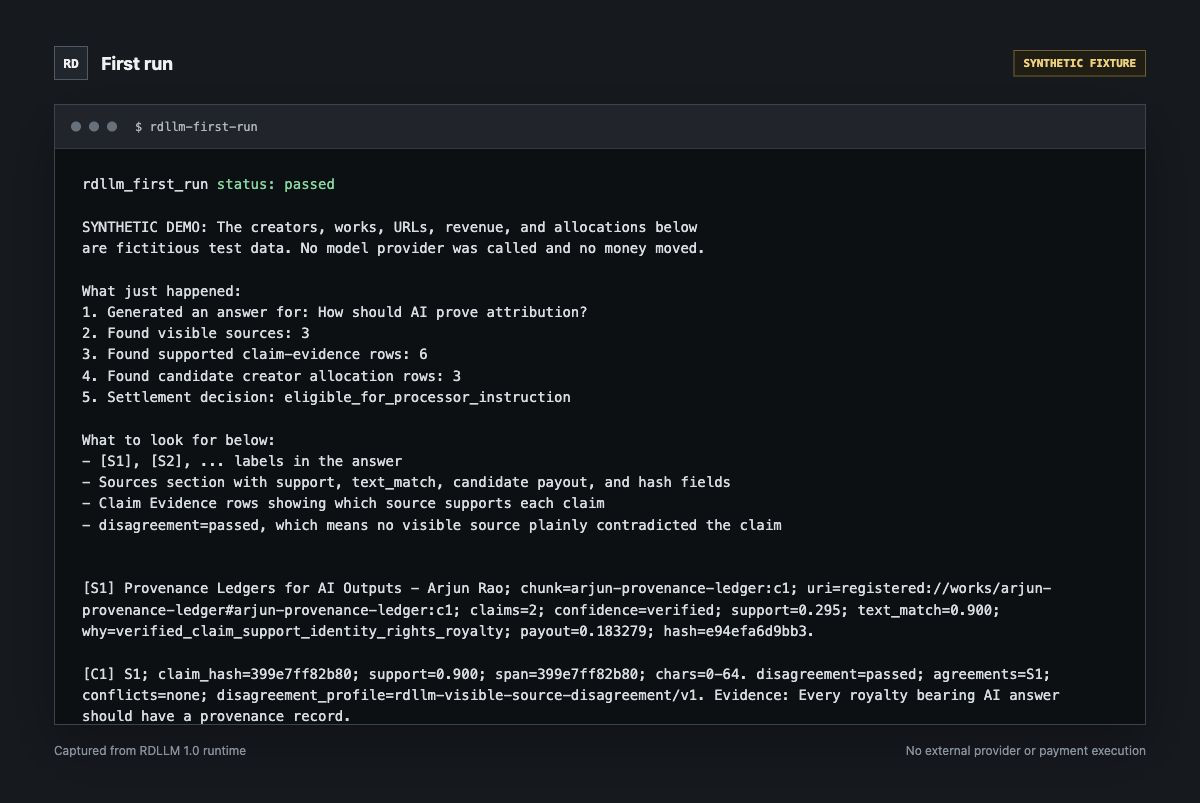
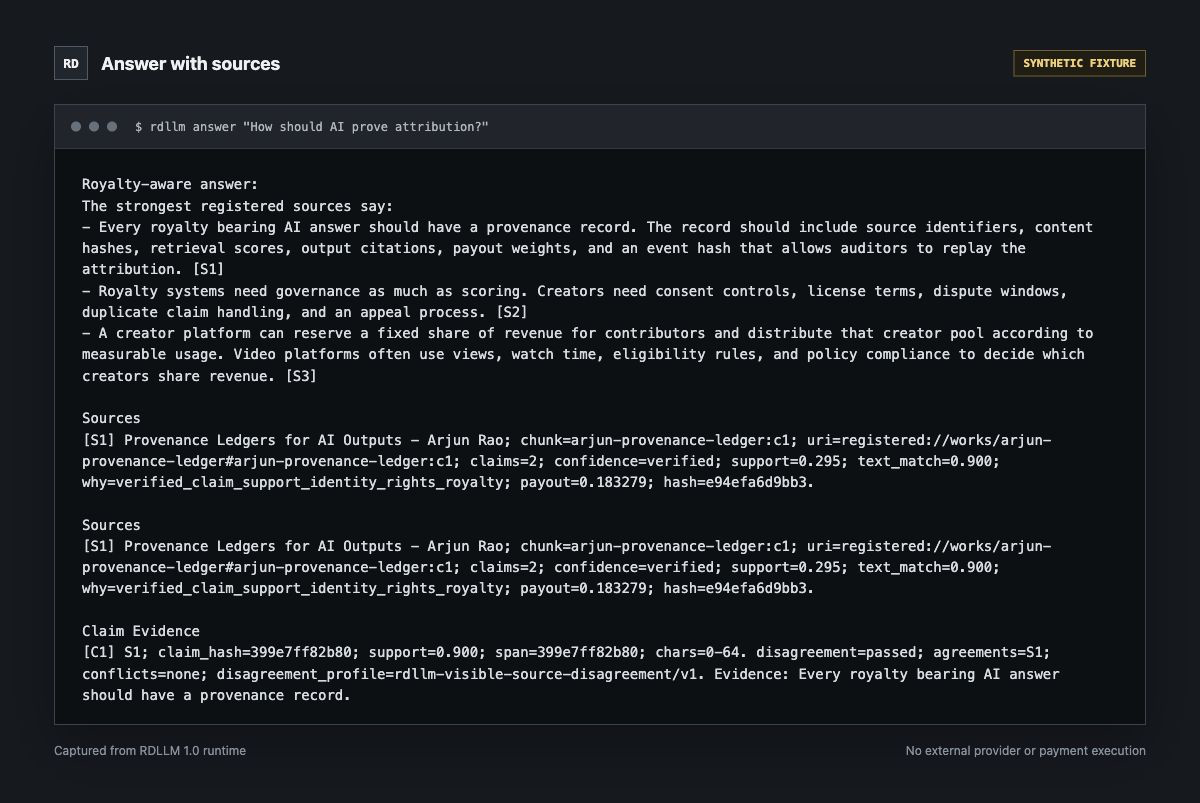
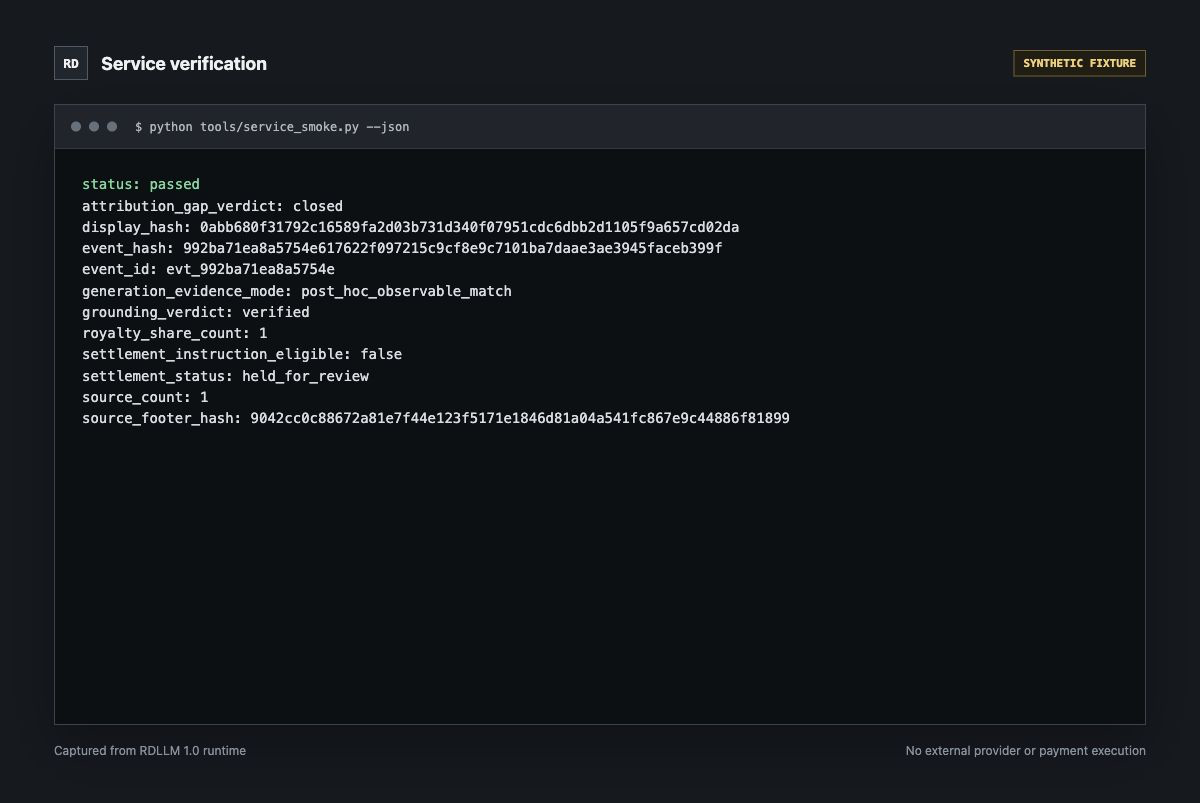
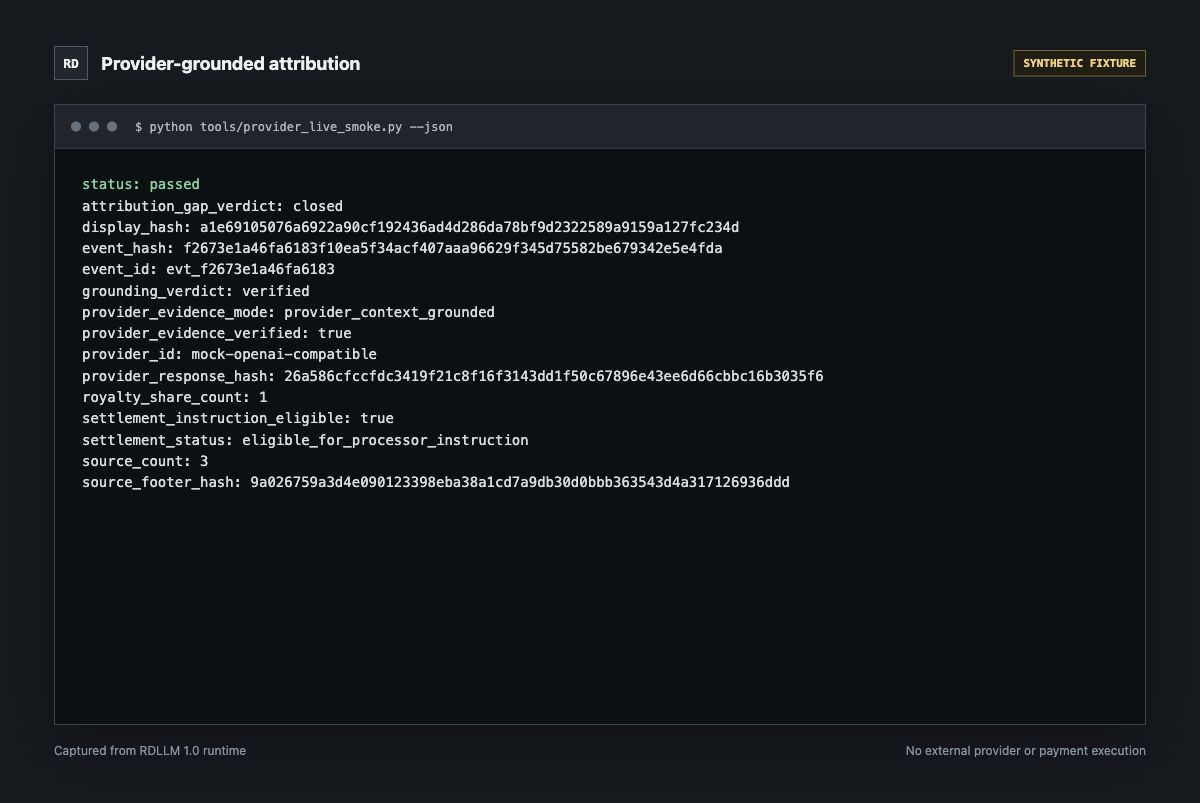
Read the screenshots this way:
status: passedmeans the command completed its own verification.Sources,[S#],Claim Evidence,support,text_match, andpayoutare the visible attribution surface.payoutis the current schema's candidate allocation field, not a payment receipt.grounding_verdict,source_footer_hash,display_hash, andprovider_response_hashare machine-checkable runtime handles.
Use Case 1: Explain Attribution In A CLI Answer
PYTHONPATH=src python3 -m rdllm.cli answer "How should AI prove attribution?"
Expected visible surface:
Royalty-aware answer:
The strongest registered sources say:
- Every royalty bearing AI answer should have a provenance record... [S1]

Sources
[S1] Provenance Ledgers for AI Outputs - Arjun Rao; ... support=0.295; text_match=0.900; ... payout=0.183279; hash=e94efa6d9bb3.

Claim Evidence
[C1] S1; claim_hash=399e7ff82b80; support=0.900; span=399e7ff82b80; chars=0-64. disagreement=passed; agreements=S1; conflicts=none; disagreement_profile=rdllm-visible-source-disagreement/v1. Evidence: Every royalty bearing AI answer should have a provenance record.
How to read it:
supporton a source row is the source's observable contribution to the final output.text_matchis the overlap signal between output text and registered source text.payoutis the candidate creator-pool amount allocated to that source owner.Claim Evidencebinds a generated claim to a source label and evidence span.disagreement=passedmeans no visible high-overlap source plainly contradicted that claim.
Use Case 2: Run The Service And Verify A Displayable Answer
Terminal 1:
export RDLLM_SERVICE_TOKEN="${RDLLM_SERVICE_TOKEN:-rdllm-local-dev-token}"
export RDLLM_SERVICE_TOKEN_SHA256="$(python - <<'PY'
import hashlib
import os
print(hashlib.sha256(os.environ["RDLLM_SERVICE_TOKEN"].encode()).hexdigest())
PY
)"
PYTHONPATH=src python3 -m rdllm.service --config examples/service_config.json
Terminal 2:
curl -sS \
  -H "Authorization: Bearer $RDLLM_SERVICE_TOKEN" \
  -H "Content-Type: application/json" \
  -d '{
    "prompt": "What should royalty-bearing AI answers expose?",
    "output": "Every royalty-bearing AI answer should expose grounded sources, claim evidence, and payout or escrow state.",
    "gross_revenue": "1.00"
  }' \
  http://127.0.0.1:8765/v1/attribute > /tmp/rdllm-response.json
Verify copied/exported display text:
python - <<'PY'
import json
from pathlib import Path
response = json.loads(Path("/tmp/rdllm-response.json").read_text())
Path("/tmp/rdllm-display.txt").write_text(response["display"]["rendered_text"], encoding="utf-8")
Path("/tmp/rdllm-footer.json").write_text(json.dumps(response["source_footer"]), encoding="utf-8")
PY
PYTHONPATH=src python3 tools/service_response_verify.py --response /tmp/rdllm-response.json --display-text /tmp/rdllm-display.txt
PYTHONPATH=src python3 tools/source_footer_verify.py --footer /tmp/rdllm-footer.json --display-text /tmp/rdllm-display.txt
The verifier must report:
production_display_ready: true
source_grounding_acceptance: passed
claim_source_disagreement_status: passed
Use Case 3: Test Provider-Backed Attribution
PYTHONPATH=src python3 tools/provider_live_smoke.py
This uses the configured OpenAI-compatible mock route by default. It verifies that retrieved source context is sent before generation, the mock answer cites a supplied source, provider evidence is captured and hashed, and the answer is rendered with a source footer before display.
Use Case 4: Check Production Launch Readiness
PYTHONPATH=src python3 tools/ship_check.py --skip-tests --skip-regenerate
PYTHONPATH=src python3 tools/production_readiness.py
Use this before publishing a release, demo, or hosted proof surface. The launch path should fail closed when source footer verification, copied-text preservation, attribution-gap closure, or settlement controls are missing. An operator deployment remains unapproved without externally signed evidence and an independent trust store, even when repository checks pass.
Use Case 5: Call The HTTP API From App Code
Use the language-specific examples in API clients.
Every example calls /v1/attribute, reads display.rendered_text, and checks
the fields that matter to a user:
- visible source footer;
- claim evidence;
- source usage metrics;
- payout or escrow state;
- verifier-ready display text.
Use Case 6: Give A Beginner A One-Command Proof
Use this in a README, workshop, demo booth, or first install path.
python -m pip install .
rdllm-first-run
Expected first line:
rdllm_first_run status: passed
This proves the package can generate a synthetic answer, show visible sources, count claim-evidence rows, and expose candidate creator allocations without an API key.
Use Case 7: Reconcile Creator Royalty Events
Use this when a creator platform or publisher wants to inspect the ledger events behind attribution.
PYTHONPATH=src python3 -m rdllm.cli demo --ledger artifacts/demo_ledger.json
Look for event IDs, royalty shares, creator-pool allocation, and receipt hashes. This is the path to show that attribution is not only a citation footer; it also becomes an auditable settlement event.
Use Case 8: Publish A Public Proof Pack
Use this before putting proof artifacts behind GitHub Pages, a static site, or a well-known discovery URL.
PYTHONPATH=src python3 tools/hosting_export.py --check
PYTHONPATH=src python3 tools/hosted_surface_audit.py
The first command checks that exported schemas and proof artifacts are current. The second checks that the hosted public surface contains the expected manifest, schemas, and RDLLM proof artifacts.
Use Case 9: Check The Public Surface For Secrets
Use this before publishing generated docs, receipts, or well-known artifacts.
PYTHONPATH=src python3 tools/public_surface_privacy_audit.py
The audit is meant for public-facing releases. It checks that exported proof files do not leak private prompts, tokens, private keys, or hidden operator state.
Use Case 10: Check Provider Family Compatibility
Use this when adding, removing, or renaming model-provider routes.
PYTHONPATH=src python3 tools/provider_matrix.py --check
PYTHONPATH=src python3 tools/provider_family_audit.py
These checks make sure provider families are consistently represented across runtime adapters, provider matrices, adoption docs, and public proof artifacts.
Use Case 11: Load-Test The Attribution Service
Use this before a hosted demo, customer pilot, or internal launch.
PYTHONPATH=src python3 tools/service_load_smoke.py
Expected output includes service_load_smoke status: passed, request count,
concurrency, elapsed seconds, and service metrics. It proves the service can
handle concurrent attribution requests while preserving ready metrics.
Use Case 12: Test Abuse, Rate Limit, And Provider-Failure Paths
Use this when RDLLM sits on a public endpoint.
PYTHONPATH=src python3 tools/security_abuse_smoke.py
Expected output includes security_abuse_smoke status: passed. It checks abuse
cases, rate limiting, and provider-failure handling so unsafe or failed requests
do not become confident grounded answers.
Use Case 13: Verify The Installable Package
Use this before tagging a release or telling users to install from the package.
PYTHONPATH=src python3 tools/package_smoke.py
This builds the wheel and source distribution, installs them in an isolated
environment, runs the demo, and verifies console scripts such as
rdllm-first-run, rdllm-service, and the verifier commands.
Use Case 14: Compare Operator Acceptance Profiles
Use this when deciding whether RDLLM is ready for an individual, company, institution, government, or public-sector deployment profile.
PYTHONPATH=src python3 tools/production_profile_matrix.py
PYTHONPATH=src python3 tools/operator_acceptance_matrix.py
The bundled profiles demonstrate fail-closed behavior: no unattested template
allows direct settlement, public-sector use, or a production-grade claim. An
operator can separately test trusted signed attestations with
rdllm-deployment-attestation verify.
Use Case 15: Audit The GitHub-Facing Documentation
Use this before publishing the repo, README, docs site, or examples to users.
PYTHONPATH=src python3 tools/docs_link_audit.py
PYTHONPATH=src python3 tools/github_docs_readiness_audit.py
These checks keep the public entry points grounded: beginner docs, live use cases, API clients, multilingual quickstarts, source-field examples, and local links all have to be present and valid.